
Strategy
What Makes an Insurance Partnership Work?
A strong brand can open the door, but successful affinity insurance partnerships depend on proposition, data, distribution, insurer fit and genuine alignment.
Jamie McCann · · 5 min read
I've spent a large part of my career working in and around affinity insurance partnerships.
And one thing I've learned is that putting a well-known brand on an insurance product doesn't automatically create a successful business.
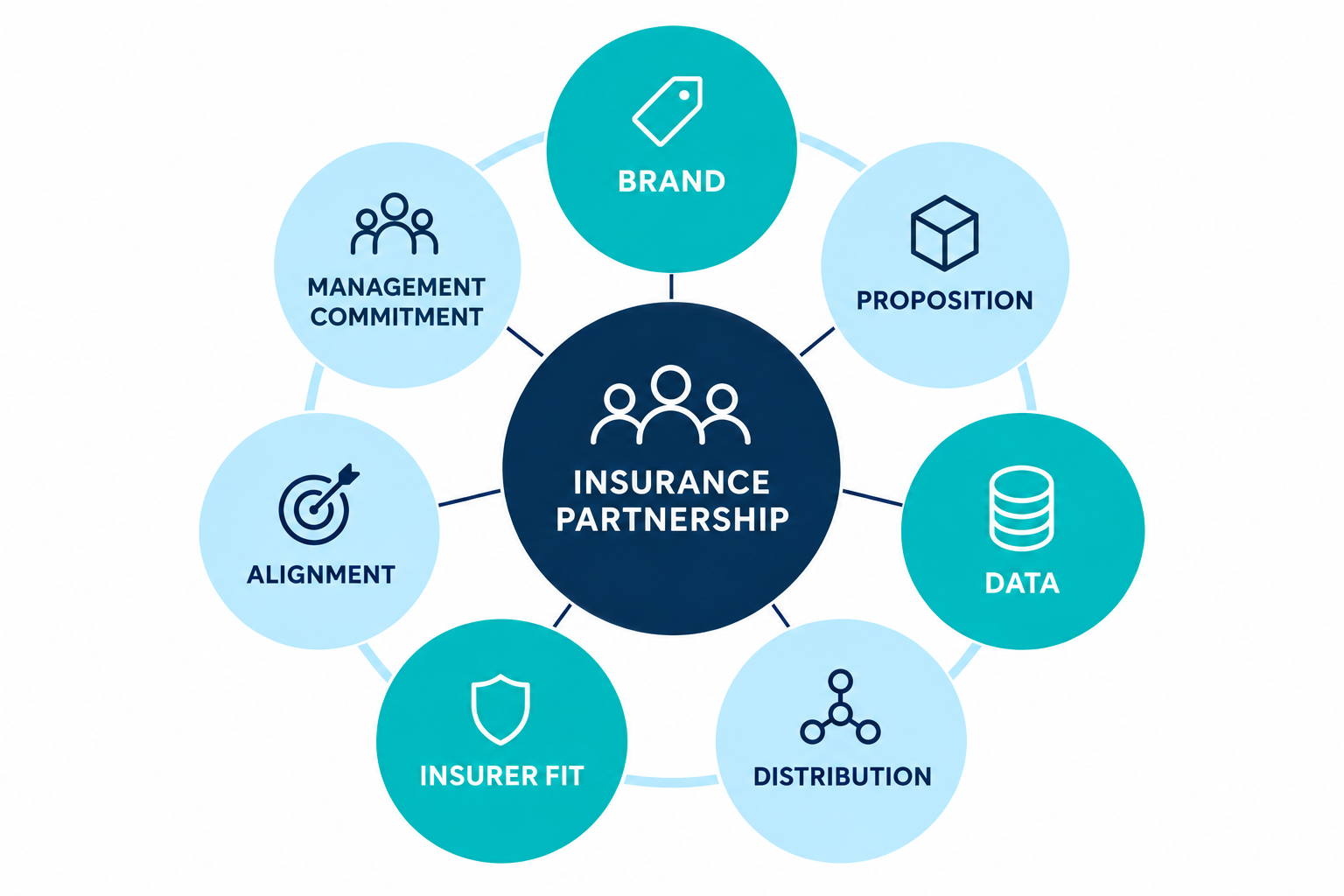
Brand can be an advantage. When reviewing an affinity insurance partnership, I look at seven factors together: brand relevance, proposition, data, distribution, insurer fit, alignment and management commitment. This is a practical framework informed by commercial experience.
There are some fundamental questions worth asking.
Does your brand naturally translate into insurance?
And, more specifically, does it translate into the type of insurance you're selling?
Brand awareness is valuable. In my experience, brand relevance and customer trust in the category often matter more than awareness alone.
Customers knowing who you are isn't necessarily the same as customers believing you have a credible reason to provide their home, motor, travel or other insurance.
The stronger the connection between the brand, the customer relationship and the insurance need, the better the foundations for the proposition.
Is your proposition actually designed for your customers?
Or are you selling a largely mass-market insurance product underneath a different brand?
The strongest affinity propositions have a reason to exist for the customers they serve.
That doesn't necessarily mean building something radically different. But there should be a clear answer to the question: why should this customer buy this insurance product from this brand?
That answer might come from the cover, service, customer journey, pricing, rewards, integration with the wider proposition or a combination of them.
Simply changing the logo isn't a proposition.
Do you have a genuine data advantage?
What does the relationship with your customers tell you that the wider market doesn't know?
Can that data improve pricing, underwriting, segmentation or the customer journey?
Affinity businesses can potentially have something insurers value enormously: an existing customer relationship and information generated through it.
But having data and having a useful data advantage aren't the same thing.
The opportunity comes from identifying what is genuinely predictive or useful, establishing a lawful basis for using the data and appropriate governance, and then turning it into something that improves decisions or customer experience.
Do you have the scale and distribution to make it work?
The volume needed to make an affinity partnership commercially viable depends on its economics, proposition and distribution model.
But scale isn't just about the size of the customer base.
Do you have unique routes to those customers? Can you embed insurance into existing journeys? Can you reach customers at moments when the product is particularly relevant?
Or are you ultimately competing for them through the same price comparison websites as everyone else?
A large customer base is clearly valuable. A large customer base combined with privileged, relevant and efficient distribution is much more interesting.
Does your insurer's appetite match your customers?
A strong brand and proposition can help, but insurer fit still matters: appropriate underwriting capacity, appetite and competitive pricing for the customers the partnership aims to serve. The trade-offs need to work within the partnership's economics.
You can have millions of customers, but if your insurance partner is only genuinely competitive for a relatively narrow part of that franchise, the addressable opportunity can shrink very quickly.
That makes panel versus solus one of the fundamental design choices. I explore those trade-offs in Panels vs. Solus — Choosing the Right Insurance Model for Distribution.
Solus can bring simplicity, alignment and deeper integration. A panel can broaden competitive footprint and increase the proportion of your customer base you can serve effectively.
Neither model is inherently right. The question is which model best fits the proposition, customer franchise and economics of the partnership.
Are your interests genuinely aligned?
Good partnerships need to work economically for both sides.
The brand and insurer won't always start with the same objectives, so the commercial model, incentives and measures of success matter.
Short-term volume can be relatively easy to celebrate. A sustainable partnership needs to work through the insurance cycle and continue making sense as pricing, claims, regulation, customer behaviour and competitive conditions change.
The best partnerships create alignment around the things that ultimately matter: sustainable growth, attractive economics and good customer outcomes.
Does management give insurance the ownership and attention it needs?
Insurance doesn't have to be the organisation's core business.
An ancillary insurance proposition can still need clear ownership, management attention and a constructive relationship with the insurance partner.
In the strongest affinity businesses I've seen, senior management understand the opportunity, care about the customer proposition and give insurance appropriate attention within the wider business.
That matters because successful partnerships require decisions and investment across proposition, data, technology, distribution, marketing, operations and customer experience.
Without that commitment, even a promising proposition can struggle to develop.
The question I'd ask
Many affinity partnerships have existed for years. Over time, commercial structures, technology, customer behaviour and insurance markets change. Decisions made for perfectly good reasons ten years ago may not be the decisions you'd make today.
Which leads to the question I'd ask anyone running a mature affinity partnership:
If you were designing the partnership from scratch today, would you build it the same way?
A useful exercise for any established affinity partnership is to revisit these seven factors together.
Where has the market moved? Where have customer expectations changed? And which parts of the original commercial model no longer work as intended?
The opportunity isn't necessarily to replace the partnership. It may be to identify the few changes that would make it more relevant to customers and more valuable to both partners.