
Strategy
Panels vs. Solus: Choosing the Right Insurance Model for Distribution
A practical guide to the trade-offs between single-insurer and panel arrangements for insurance distributors and retailers.
Jamie McCann · · 7 min read
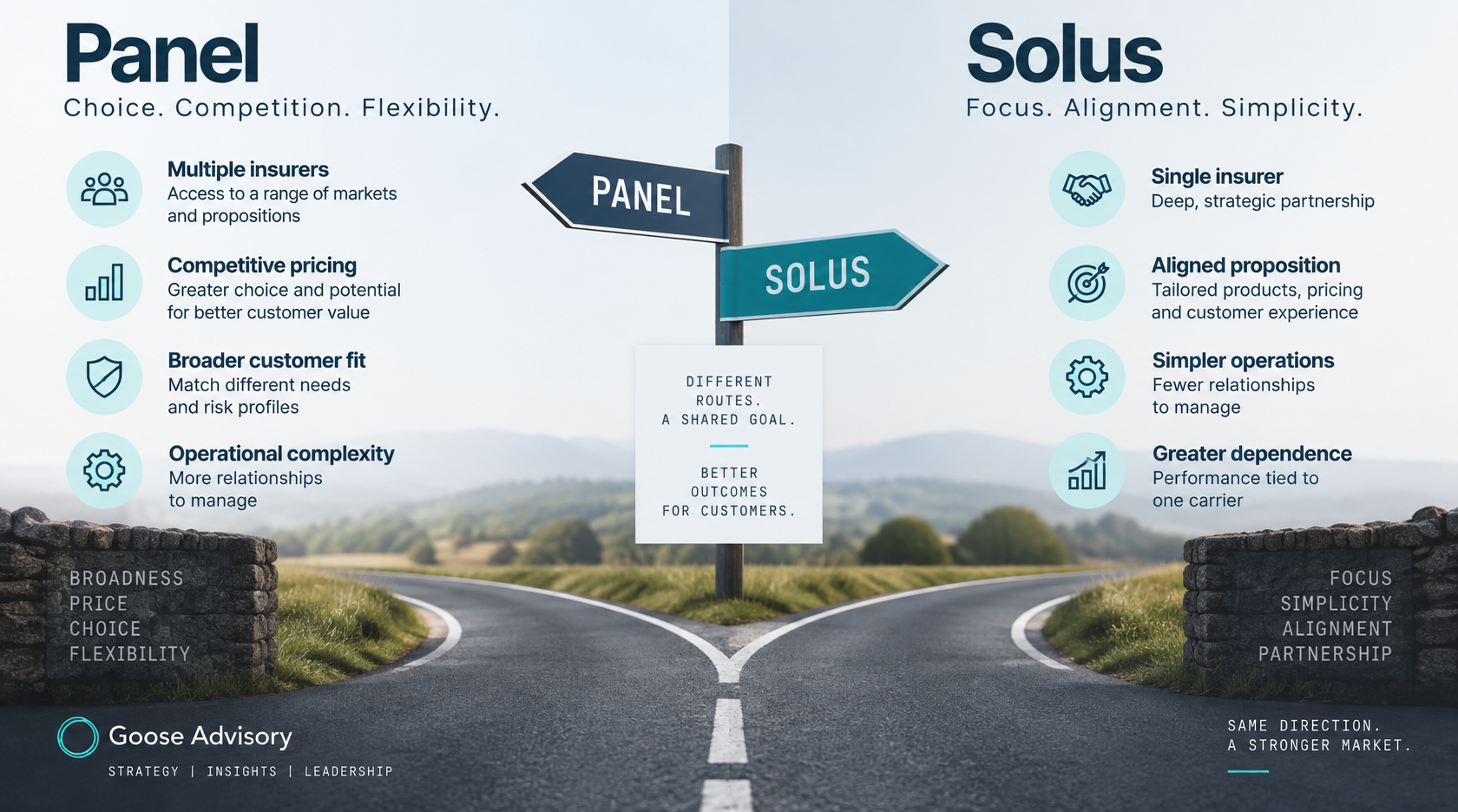
When a retailer or distributor decides to offer insurance, one of the first structural questions is: do we partner with a single insurer, or do we build a panel of insurers to compete for risk?
Both approaches can work. Both have their champions. And both come with trade-offs that affect customers, partners, and long-term commercial value.
At Goose Advisory, we've worked across solus and panel models in UK general insurance. What follows is a practical guide to the pros and cons of each, and some thoughts on how to choose what's right for your business.
The Panel Model
A panel brings together multiple insurers who underwrite policies under a single retail or distributor brand. Customers receive quotes from several carriers, with pricing and product terms varying according to each insurer's risk appetite and models.
Pros for distributors and retailers
- Competitive pricing. With multiple insurers vying for risk, pricing is sharper. For commoditised products like motor and home, this can be decisive in winning customers.
- Risk diversification. No single insurer carries all the risk. If one carrier tightens appetite, others can step in.
- Breadth of cover. Different insurers often bring varied products or niche underwriting strengths, which can broaden the proposition and reduce decline rates.
- Negotiating leverage. Panels keep insurers on their toes, which can give the distributor stronger terms on commission, service levels, or marketing support.
Cons for distributors and retailers
- Complexity. Panels require more systems integration, pricing alignment, and operational oversight. Customer journeys can suffer if insurers' data or claims processes differ.
- Inconsistent customer experience. Two customers buying the same branded product may be with different insurers, with different claims experiences and outcomes. That can erode trust in the retailer's brand.
- Diluted partnerships. Insurers may treat panel slots as transactional, not strategic, and offer their best innovation to solus partners.
- Margin tension. Competing insurers can undercut each other, sometimes at the expense of sustainable profitability and eventually the panel itself.
The Solus Model
A solus model is a single insurer, or occasionally an MGA, taking the exclusive underwriting role. The retailer's entire insurance proposition sits with one carrier.
Pros for distributors and retailers
- Simplicity. One product set, one claims process, one capacity relationship. This makes the customer journey consistent and easier to manage.
- Stronger alignment. Solus deals create real partnerships. Insurers have skin in the game and are incentivised to invest in product innovation, marketing, and service.
- Commercial depth. A single partner is often willing to commit more, through higher commissions, brand investment, or joint ventures, because they have exclusivity.
- Speed to market. Building and maintaining one integration is faster and cheaper than multiple insurer connections.
Cons for distributors and retailers
- Concentration risk. If the insurer withdraws or reprices aggressively, the retailer has no fallback. This can be particularly challenging in hard markets.
- Less competitive tension. Without rivals on the panel, pricing can drift, and customers may see less value over time.
- Dependence on one partner. Culture clashes, claims issues, or strategic misalignment can leave the retailer exposed.
- Reduced breadth. One insurer may not cover all niches or subsegments, limiting proposition scope.
A Retailer's Dilemma
Imagine a large retailer entering the motor insurance market.
- Panel option. They launch with four insurers on a panel. Pricing is sharp, conversion strong, and they capture market share quickly. But claims feedback starts to vary. Customers buying under the retailer's brand don't realise they're dealing with different carriers until something goes wrong, and complaints hit the retailer, not the insurer.
- Solus option. The retailer instead partners with a single insurer. Pricing is slightly less competitive, but customer journeys are smooth, marketing is aligned, and the insurer invests in product features tailored to the retailer's audience. Over time, the retailer builds brand trust, but loses some sales to competitors with sharper panel-driven pricing.
Both models work. The better choice depends on the retailer's strategy: is the priority short-term price competitiveness or long-term brand trust and aligned partnership?
What Insurers Think
- Panels. Attractive for testing new channels and gaining incremental volume without overcommitting. But insurers worry about being commoditised and treated as interchangeable.
- Solus deals. Resource-intensive, but they offer depth, scale, and long-term stability if the partnership works. They also allow insurers to showcase product innovation and data capabilities.
The health of the relationship between distributor and insurer is as important as the structure. An unbalanced solus deal or a chaotic panel can both lead to poor outcomes.
Choosing Between Panel and Solus
There's no universal right answer. These questions can help frame the decision:
- What is your brand promise?. If it's about lowest price, a panel gives the sharpest edge. If it's about trust and consistency, solus delivers more control.
- How mature is your insurance operation?. Early-stage entrants may find solus simpler to manage. Experienced distributors with strong systems can handle panels.
- What is your risk appetite?. Solus carries concentration risk. Panels reduce dependency but increase complexity.
- What matters most to your customers?. Breadth and price may point to a panel. Consistency and service may point to solus.
- Where is the market cycle?. In soft markets, panels often deliver better customer value. In hard markets, solus partners may offer stability and investment.
Product differences also matter. In home insurance, a single insurer can usually cover a broad spread of risk, making solus arrangements more viable and less exposed. In motor, appetites diverge more sharply, for example around young drivers, high-performance cars or urban postcodes. That makes panels more attractive in motor, as no single insurer is likely to cover the full market without creating gaps or amplifying concentration risk.
Our View
At Goose Advisory, we've seen both models succeed and both models fail. The difference isn't just in the structure. It's in how the model is managed, governed, and aligned to strategy.
- Panels. Work best when tightly controlled, with strong data integration and clear customer communication. Without this, they quickly become messy.
- Solus deals. Work best when there is deep trust and shared goals. Without this, dependency becomes a weakness.
The key is clarity: know what you're optimising for, be honest about your operational capabilities, and choose the model that fits both your brand and your customer promise.
Final Thought
In distribution, strategy is as much about how you carry risk as it is about who you sell to. Whether you choose a panel or a solus arrangement, the model should reflect your priorities: customer outcomes, brand promise, and long-term sustainability.
At Goose Advisory, we help distributors and retailers cut through these choices, weigh the trade-offs, and build insurance propositions that deliver for customers and partners alike.